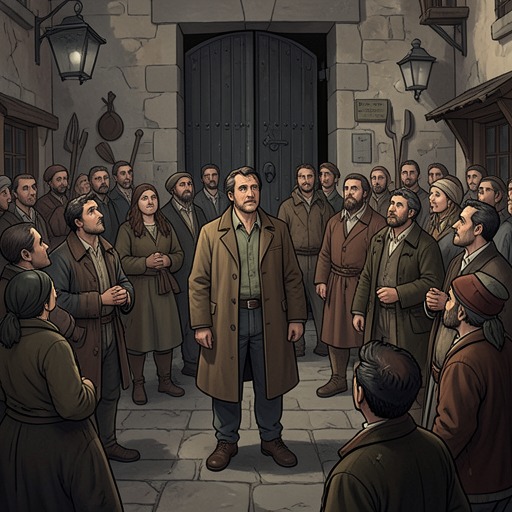
Antek is chosen to lead the villagers
The PeasantsAntek is chosen to lead the villagers when confidence in the blacksmith’s efforts to secure an agreement falters. The choice turns a dispute about who can speak for Lipce into a test of trust: the villagers want someone they believe can command attention, understand their interests, and act for the community rather than for private gain.
Background and Stakes
The meeting takes place amid grievances that have made collective action urgent. In an earlier dispute over the manor’s felling of Wolf’s Hollow woodland, villagers had expected the work to provide wages, but heard that The Squire would employ no one from Lipce. At least twenty hired hands were desperate for work; the winter was severe, potatoes had frozen for some, and families faced a hungry, impoverished period before the harvest. Opposition to the felling therefore involved both a claim about the forest and a struggle over access to work and subsistence.
The village’s hardship extends beyond the hired hands. A report about Filipka’s household describes a freezing cottage, straw stuffed into the windows, a sold quilt, and a daughter weakened by hunger. With Filip in prison, the family had no dependable means to secure food; another household faced illness, childbirth, fallow fields, and the absence of a husband imprisoned with the other men. These accounts make the question of leadership more than a matter of prestige: decisions made in the village affect people with little reserve against hunger, lost labor, or debt.
The villagers’ anger also has a history of failed recourse. In a public denunciation of the manor’s actions, Antek Boryna had invoked confiscations, injuries, and complaints that brought no remedy, before presenting the felling as the last straw. That earlier speech shows him articulating shared grievances in collective terms. The later choice of him as leader is consistent with that capacity to give public shape to discontent, though the meeting’s immediate problem is how to secure agreement rather than how to stage another protest.
Why the Blacksmith Loses Their Trust
The meeting exposes a division between effort and credibility. The blacksmith rises heatedly to declare that he has the village’s good at heart and has labored to obtain agreement. But Mateusz the Young Villager objects that the blacksmith is pursuing his own profit and is aligned with the manor. In Mateusz’s judgment, people may listen to the blacksmith without following him. The distinction is decisive: a negotiator’s claim to represent the village is not enough if villagers suspect that his interests run alongside those of the manor.
The blacksmith challenges the critics to find someone else who can do better. Rather than defend his reputation further, Mateusz proposes Antek Boryna. His nomination redirects the discussion from the blacksmith’s self-presentation to the question of who can actually unite the villagers. Sarcastic voices suggest the priest or the miller, but Mateusz insists that Antek is the person who should take responsibility. The proposal is a public challenge as well as an expression of confidence: if Antek cannot bring the village to its senses, Mateusz argues, the whole undertaking may as well be abandoned.
Antek Accepts the Charge
Antek Boryna does not immediately claim authority. He stammers, asking who would listen to him, even as those around him answer that he has good sense, stands first in the village, and can command a hearing. Their response makes the leadership offered to him collective rather than self-appointed. The assembled villagers affirm his standing before he has agreed to act, turning private confidence in his judgment into an open mandate.
He eventually answers that nothing is gained without trying and says he will discuss the matter soon. His acceptance is cautious: he promises an attempt, not a guaranteed settlement or a particular course of action. As the meeting breaks up, villagers approach him one by one to persuade him and promise their support. Kłąb describes the desired leader as someone with intelligence, strength, and honesty; Mateusz adds, laughing, that such a person must also be able to use a stick if necessary. Their remarks join deliberation to force, presenting leadership as a combination of judgment, moral credibility, and the capacity to hold a divided community together.
Significance and Limits
The episode marks a shift in who the villagers are prepared to trust. The blacksmith has made visible efforts on the village’s behalf, yet those efforts cannot overcome suspicion that he is too closely connected to the manor. Antek Boryna’s authority, by contrast, is affirmed by others: Mateusz nominates him, the villagers endorse him, and individuals repeat their pledges as the group disperses. The scene makes recognition—not a formal appointment—the basis of his leadership.
The choice also gathers separate kinds of grievance into a shared political problem. The forest dispute has exposed the villagers’ conflict with the manor and the insecurity of hired work; accounts of hunger and imprisoned laborers reveal how quickly hardship spreads through households. In that setting, choosing a representative means deciding who can speak for people whose needs are not equally visible or equally served. The evidence establishes Antek’s acceptance and the villagers’ promise to follow him, but does not specify the agreement he will pursue or whether he ultimately secures one. The moment’s significance lies in the decision to entrust him with the attempt.